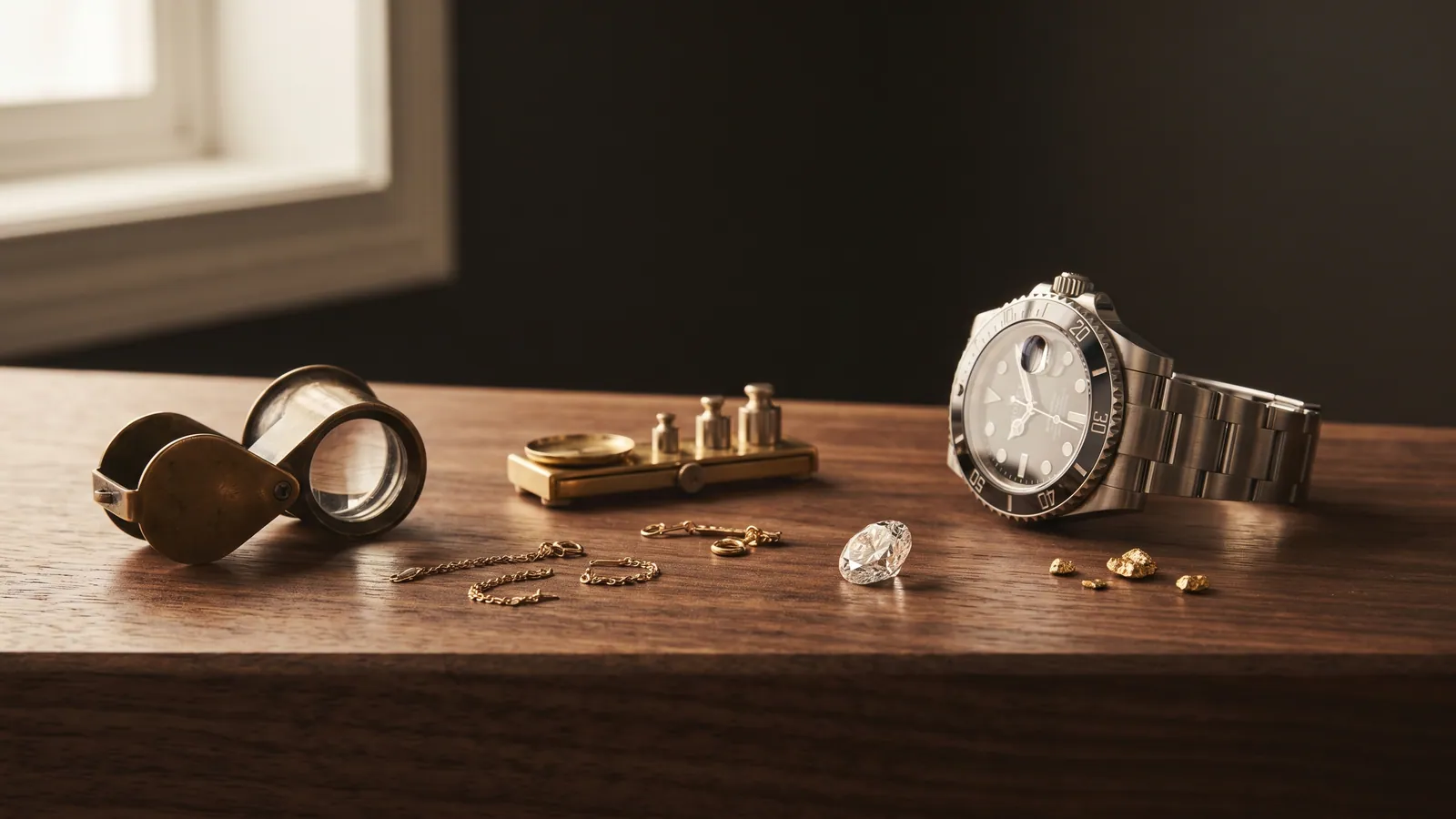
The short version: When you sell gold, the offer is mostly math — weight times purity times the day's spot price, minus the buyer's cut. When you sell a Rolex, a certified diamond, or a piece of estate jewelry, the offer is not mostly math. It's a judgment about what someone else will pay for that exact piece, and that judgment is where you either capture real value or leave it on the counter. This guide explains the difference, in plain numbers, so you walk in knowing what your piece is actually worth before anyone makes you an offer.
If you live in Jupiter, Palm Beach Gardens, or anywhere along the Treasure Coast and you've got gold, a watch, or jewelry you're thinking about selling, you've probably noticed something: every shop says they pay "top dollar," and not one of them tells you how the number gets built.
We're a third-generation family jeweler on Military Trail, GIA-trained, and we've sat on both sides of that counter for over forty years. So here's the honest version — the one most "we buy gold" pages won't put in writing.
There are really two kinds of sale happening under the same banner. Selling scrap gold is one. Selling something with resale value, like a luxury watch, a graded diamond, or a designer or estate piece, is a completely different transaction with completely different math. Most sellers lose money because nobody told them which one they were actually doing.
Let's fix that.
Walk into any buyer with a 14k chain and a Rolex Submariner and you're really carrying two different assets, even though both are "gold."
The chain has melt value — what the metal is worth if it gets melted down. That number is close to fixed: weight, purity, today's spot price, done.
The Submariner has resale value — what the next buyer will pay to wear it. That number can be five, ten, fifteen times its melt value, because nobody melts a Submariner. They sell it to the next person who wants one.
A buyer who treats both items as melt is doing you a favor on the chain and quietly robbing you on the watch. That's not a conspiracy; it's a business model. Scrap buyers are built to pay melt, because melt is all they do. The problem is when they apply that model to a piece that's worth far more assembled than melted — and don't mention the difference.
So before you sell anything, sort it into one of these two piles:
We'll be straight with you about the melt pile: if all you've got is scrap gold and bullion, a dedicated precious-metals and coin dealer will often live closer to spot than a full-service jeweler does, because that's their whole business. We won't pretend otherwise. Where we earn our keep is the resale pile: the watch, the diamond, the estate collection. Those are the pieces where a wrong valuation costs real money, and where GIA training is the difference between a fair number and a lowball.
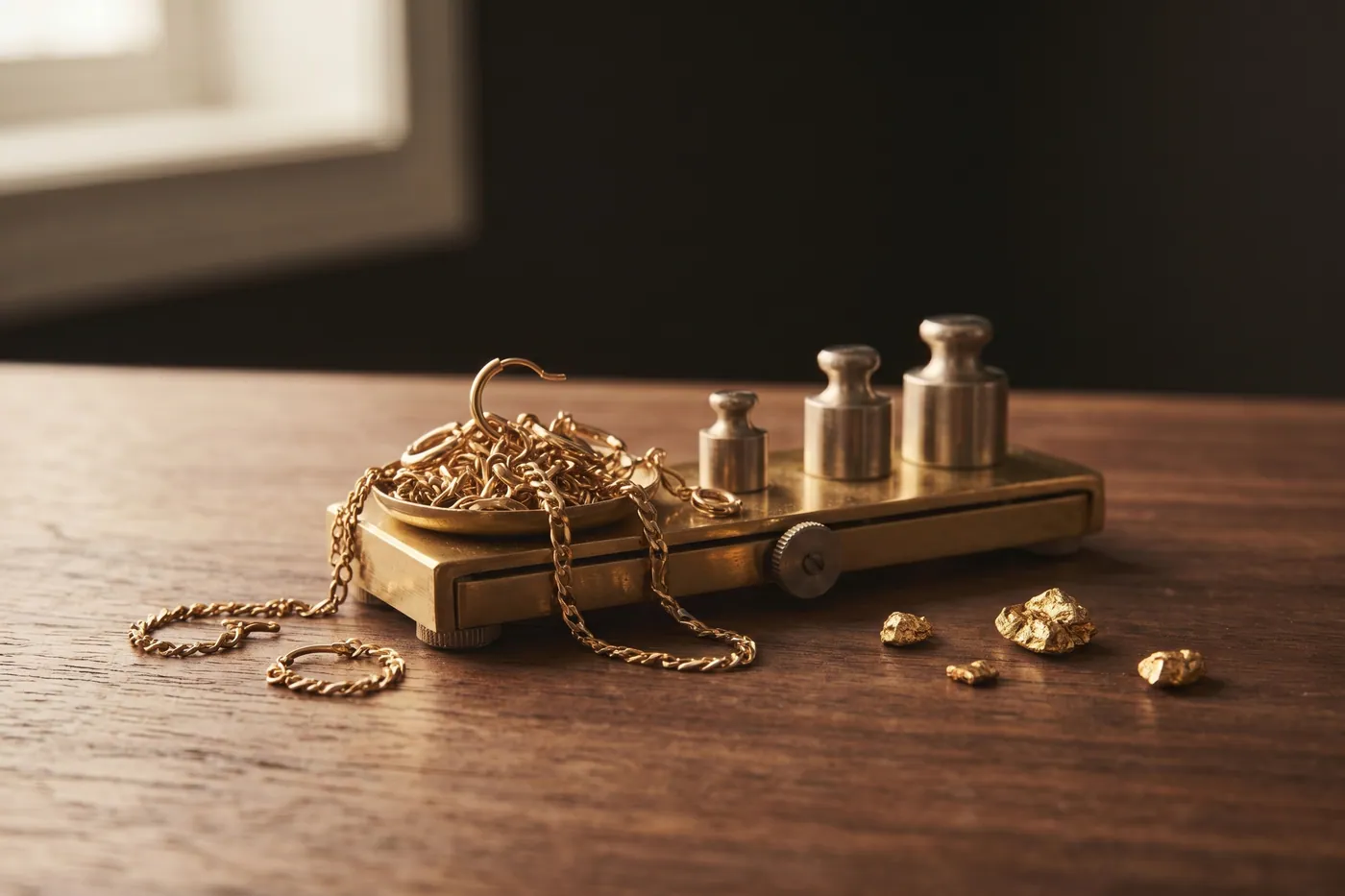
This is the part that's genuinely simple, so we'll make it fully transparent.
The price of gold is quoted as a spot price — the live market price for one troy ounce of pure (24k) gold. As of early 2026 that number moves daily; you can check it before you walk in. Everything else is arithmetic from there.
Your jewelry isn't pure gold. Karat tells you how much it is:
| Stamp | Purity | What it means |
|---|---|---|
| 24k | 99.9% | Pure gold (rare in jewelry — too soft) |
| 22k | 91.6% | High-purity, often imported |
| 18k | 75% | Common in fine jewelry |
| 14k | 58.5% | The U.S. workhorse |
| 10k | 41.7% | Minimum to be called "gold" in the U.S. |
Melt value = weight in grams × purity × (spot price per gram). A 20-gram 14k chain is really about 11.7 grams of pure gold (20 × 0.585). Multiply that by the per-gram spot and you have its melt value. That's the ceiling for scrap.
No honest buyer pays 100% of melt — they have to refine it, carry the risk, and make a living. So the real question is what percentage of melt you're being offered:
Here's the one question that separates a fair gold offer from a bad one, and you should ask it out loud: "What spot price are you using today, and what percentage of melt is this offer?" A buyer who answers cleanly is doing honest math. A buyer who gets vague, changes the subject, or says "it's just our standard rate" is hoping you won't do the multiplication yourself. (See how we structure a gold offer.)
That's the whole scrap game. It's a commodity, the math is public, and you should absolutely shop it. Now the part nobody explains.
This is where the melt formula falls apart — and where most of the money is won or lost.
A 2-carat diamond solitaire might contain a few grams of gold in the setting. Melt that ring and you'd get maybe forty or fifty dollars of metal. But the diamond could be worth thousands. A Rolex Daytona is a few ounces of steel and gold; its metal melt is almost meaningless against what someone will pay to wear it on their wrist next week.
Resale value isn't built from weight and purity. It's built from demand for that specific piece. Four things drive it:
A buyer who quotes you melt on a resale-pile item is either not equipped to evaluate it or is counting on you not knowing the difference. Either way, you walk.
This is the table we wish every seller saw before they sold anything valuable. It's the single most important thing on this page.
| Your piece | Priced on melt? | What actually moves the number | Typical resale vs. metal/retail |
|---|---|---|---|
| Scrap / broken gold | Yes | Weight × purity × spot, minus refining cut | ~70–85% of melt (fair) |
| Gold bullion (coins/bars) | Yes | Spot price, minimal handling | ~95–98% of spot |
| Luxury watch (Rolex etc.) | No | Model demand, condition, service history, box & papers | Strong models hold value; box + papers add ~10–20% |
| Certified diamond | No | The 4Cs + GIA certificate | ~20–60% of original retail; cert removes buyer's risk discount |
| Uncertified diamond | No | Same 4Cs, but buyer discounts for grading risk | Below a certified equivalent |
| Lab-grown diamond | No | Real, but a thin resale market | ~10–30% of retail — know this before you sell |
| Signed / designer jewelry | No | Maker (Cartier, VCA, Tiffany), provenance, completeness | Brand premium far above melt |
| Generic estate jewelry | Sometimes | Depends entirely on stones, maker, era | Get it identified before you sell |
Figures are general market ranges for educational purposes, not an appraisal. Your specific piece is valued in person. Verify the live gold spot price independently before any sale.
Read that table twice. The whole left column, "Priced on melt?", is the entire decision. If the answer is No, then anyone weighing your piece and quoting a melt-based number is leaving most of its value out of the offer.
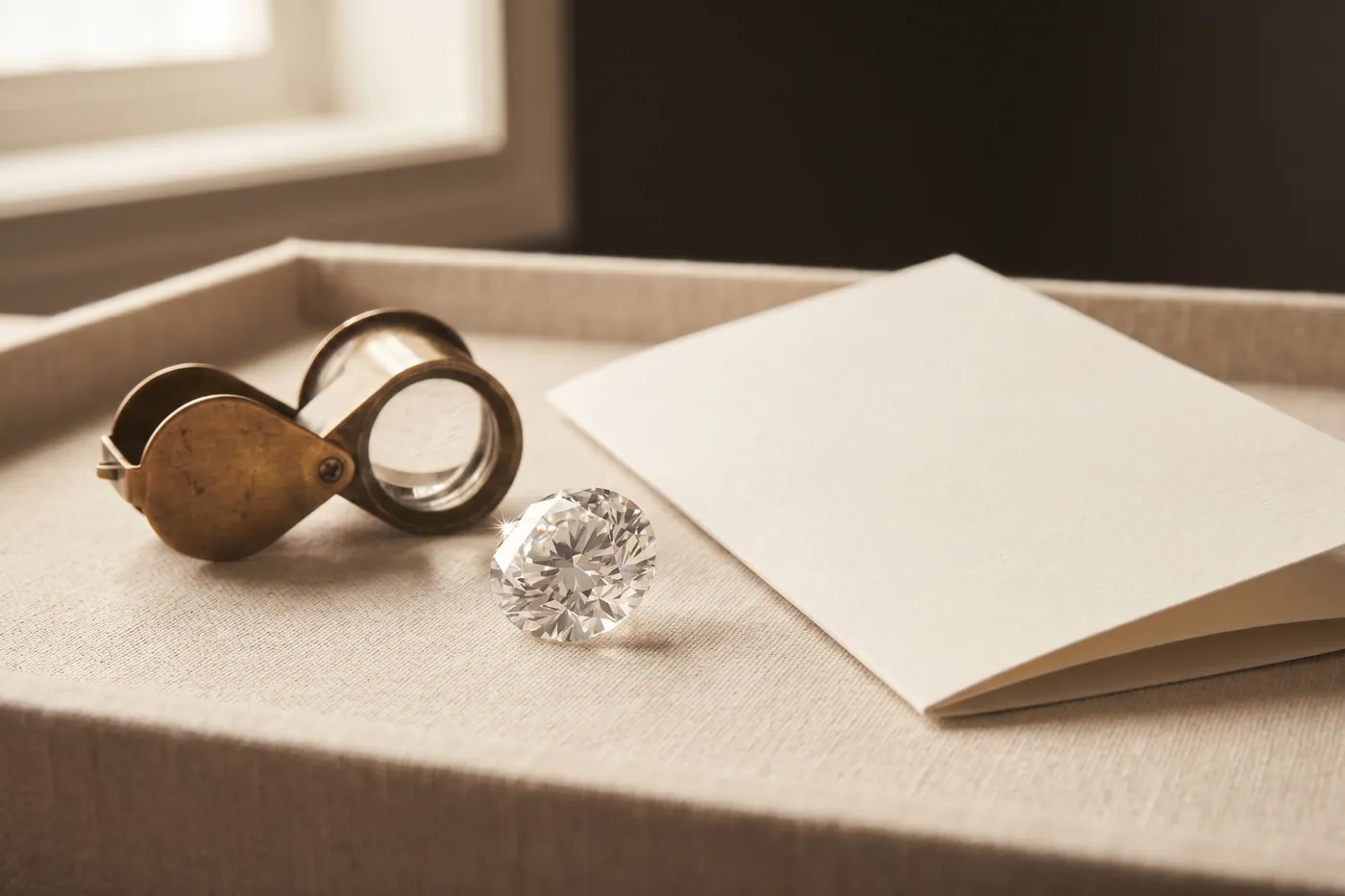
People hear "a GIA certificate raises your diamond's value" and assume it's a sales line. It isn't, and the reason is worth understanding because it tells you exactly how resale pricing thinks.
A diamond's value lives in its 4Cs — carat, color, clarity, cut. The catch: color and clarity are judgment calls, and a half-grade either way can mean a meaningful change in price. When a buyer evaluates an uncertified diamond, they have to protect themselves against being wrong. So they assume the lower grade and discount accordingly. That discount comes out of your pocket.
A GIA certificate, issued by the Gemological Institute of America, the global standard-setter, removes that guesswork. The grades are independent and trusted, so the next buyer doesn't have to hedge. That's why certified diamonds resell stronger: not because the paper is magic, but because it eliminates the risk the buyer was charging you for.
Two things to take from this:
This is the work we do. Our team is GIA-trained, which means we grade the stone, account for the certificate, and price it on what it's actually worth in the resale market — not on what the metal weighs. (How our appraisals work.)

Watches are where the gap between melt and resale is the widest — and where the value drivers tend to live on the buyer's website, not yours. These are the things that actually move a Rolex number, in plain terms:
Notice that none of those are about weight. A buyer who weighs your Rolex is buying a metal bracelet and ignoring the watch. (We buy, sell, and trade Rolex.)
If you bought it here, or you're considering a trade toward a different piece, a trade can sometimes net you more than a straight sale, because you're capturing retail value on the new piece. That's a conversation worth having before you sell outright. Bring the watch in and we'll tell you honestly what it's worth as a sale and as a trade — no pressure either way.
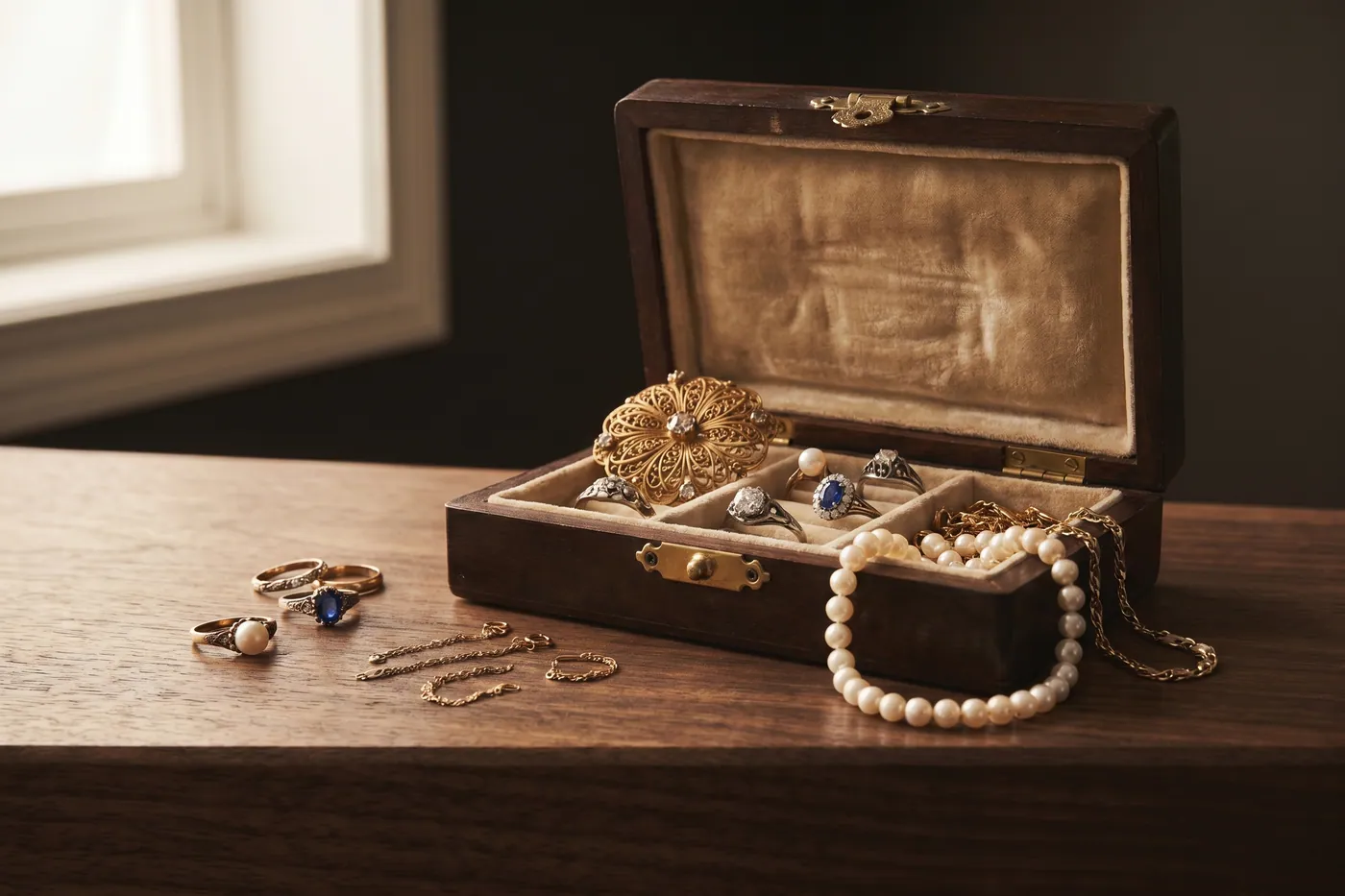
Estate jewelry is the category where sellers lose the most, because they often don't know what they have. A box from a family member might hold a signed Art Deco brooch worth a real premium, a handful of melt-grade gold, and a diamond that's never been graded — all mixed together.
The mistake is selling the whole box to a scrap buyer who pays melt across the board. The intact pieces, the signed maker, the older mine-cut diamonds — those can carry value far above their metal weight, and once they're melted, that value is gone for good.
The right first move isn't selling. It's identifying. Before you accept any offer on an estate collection, have it looked at by someone qualified to spot what's actually in there — maker's marks, period, gemstone quality, whether anything should be graded. Then you can make a real decision, piece by piece, instead of selling a Cartier brooch for the price of its gold.
You also have a choice most scrap counters don't offer: outright sale versus consignment. An outright sale is immediate and certain. Consignment can capture more on a high-value piece, but it takes longer. The right answer depends on the piece and how fast you need the money — and a jeweler who handles estate work can walk you through both. (See how we handle estate pieces.)
There's no single answer, and any page that gives you one is selling you something. It depends entirely on what you're selling. Here's the honest breakdown:
Match the buyer to the piece. Scrap to the scrap specialist. Resale to the resale specialist. The expensive mistake is taking a resale-pile item to a melt-only buyer and never knowing what you left behind.
Most of what's above is information a buyer benefits from you not having. We're putting it in writing anyway, because that's the whole point of a third-generation name on a building.
We're not going to tell you we'll out-pay a bullion dealer on a broken chain. We won't, and anyone who promises that is bluffing on the melt pile. What we will do is value your watch, your diamond, your estate pieces, and your designer jewelry on what they're genuinely worth in the resale market, show you the math, and pay true value on quality pieces. We can also do the one thing a scrap counter never can: put that value toward a trade, so you capture retail on the next piece instead of just cashing out. GIA-trained, transparent, face-to-face, same-day. That's the part the melt-only buyers can't match, because it's not their business.
If you've got something in the resale pile and you want to know what it's actually worth, not what it weighs, bring it in. The appraisal is free, and you're under no obligation to sell. (Visit us or book an appraisal.)
Golden Anvil Jewelers — 4601 Military Trail #104, Jupiter, FL 33458. Third-generation, GIA-trained. Buy · Sell · Trade · Appraise. About our family.
How much should I get when I sell gold? For scrap karat gold, a fair offer is generally in the range of 70–85% of its melt value (weight × purity × the day's spot price). Bullion coins and bars sell closer to spot — often 95–98%. Always ask the buyer what spot price they're using and what percentage of melt they're paying.
What's the difference between melt value and resale value? Melt value is what the metal is worth if it's melted down — fixed by weight, purity, and spot price. Resale value is what the next buyer will pay for the piece intact, which for a luxury watch or certified diamond can be many times its melt value. A buyer who quotes melt on a resale-pile item is leaving most of its worth out of the offer.
Does a GIA certificate increase my diamond's resale value? Yes. A GIA certificate provides independent, trusted grading of the diamond's 4Cs, which removes the next buyer's uncertainty. Without it, a buyer discounts the stone to protect against being wrong about its grade — and that discount comes out of your payout. Bring the original certificate if you have it.
How much does a Rolex sell for without box and papers? The original box and papers commonly add roughly 10–20% to a Rolex's value, so selling without them typically lowers the offer by a similar margin. They prove provenance and originality. The watch still has real value without them — but with them, it's worth meaningfully more.
Is it better to sell gold to a jeweler or a pawn shop? For resellable pieces (luxury watches, certified diamonds, designer or estate jewelry), a jeweler usually pays more, because a jeweler can evaluate resale value and offer a trade, while a pawn shop prices for the worst case. For plain scrap gold or bullion, a dedicated precious-metals dealer often pays best. Match the buyer to the piece.
Where can I sell estate or inherited jewelry near Jupiter, FL? Get the collection identified by a GIA-trained jeweler before selling, so intact and signed pieces aren't sold for scrap value. A full-service jeweler can also offer a choice between an immediate outright sale and consignment for higher-value items.